Prefazione al libro “Nessuno è Peter Pan”
Nessuno è Peter Pan
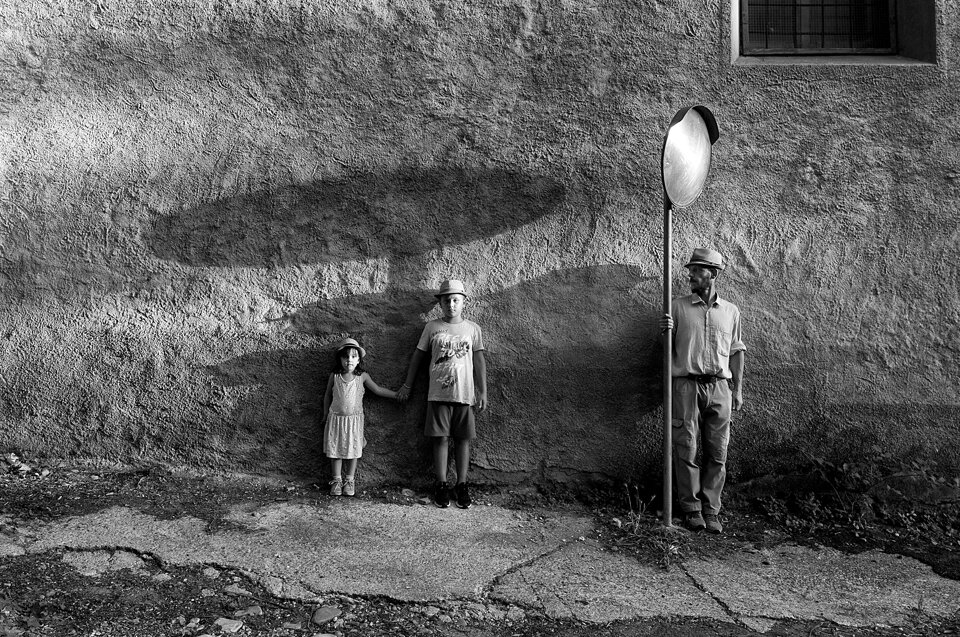
"Si fotografa per la luce" ma ogni luce proietta un ombra, il suo opposto. Mi piace provare a dialogare con l'opposto, con l'altro; per questo ho scelto di ragionare sulle ombre. Certamente Platone e "Il mito della caverna" mi hanno preceduto, come lo hanno fatto Barrie e poi Disney con Peter Pan. Testimonia che le ombre attraggono il genere umano da sempre. Lo attraggono e lo impauriscono. Perchè ciò che non proietta un'ombra non è eterno. Ahimè ricordo che nessuno è Peter Pan, tutti abbiamo un'ombra... . Forse è questo il mio terrore panico.
Ma sono un Surrealista. Preferisco nascondere la paura tra le pieghe del sarcasmo, mettendo in crisi il reale, evidenziandone gli opposti, spesso assurdi. Le ombre sono una chiave per mettere in comunicazione due mondi. Perchè, nel mio credere, tutti abbiamo personalità multiple, a seconda delle situazioni, e le ombre mi consentono di esplorarle. La bivalenza e l'equilibrio.Sfogliando il libro troverete 37 fotografie, 18 dittici in doppia pagina e la foto di chiusura. Buona immedesimazione.
di Carlo Ferrara
Gli amici degli amici sono miei amici. È in sintesi quello che stiamo vivendo oggi nel mondo social. Potrebbe sembrare superficiale, è invece il modo attuale di fluire. Si creano spontanei torrentelli di cultura, di arte. Non seguono i canali ufficiali, scorrono quasi sotterranei nei meandri del web per poi emergere, tracimare freschi in un fiume reale. Ci si fiuta, ci si riconosce, ci si incontra, non del tutto per caso. Nel 2019 Carlo Ferrara è uno dei 25 finalisti del premio ArteLaguna di Venezia, scopre un mondo reale a lui ancora sconosciuto. Più di 15.000 visitatori in 30 giorni. Artisti da tutto il mondo insieme. Siamo sempre di più a conoscere Carlo. Seguiamo giorno per giorno le nuove avventure dell’omino col cappello. È la personificazione emblematica di ogni possibile omino col cappello. Si è calato, nello scorrere di un tempo più mentale che cronologicamente determinato, in diversi personaggi: il saltatore, epigono di uno spiazzante grillo parlante, imbarazzante quanto la propria coscienza. Il doppio, il corniciaio. Incontri con se stesso, con noi, reportage dell’insolito nel quotidiano, in un viaggio a km 0, nei dintorni della Stazzano dove abita. Luoghi abbandonati nella campagna sono le sue location, spesso avvolte nella nebbia. Giorno dopo giorno il personaggio ha iniziato a modificarsi, ora indaga di più dentro sé , coinvolge l’osservatore nel fare altrettanto. Raggi di sole, come sciabolate fendono la nebbia, creano ombre più nette. In questo libro è l'interlocutore. interloquisce con le ombre. Ci coinvolge in un quotidiano, perdurante, presente. Sospeso in un limbo, tra un prima e un poi, in perpetua agitazione e sperimentazione. Solo sperimentando con curiosità si resta vivi, eterni bambini. Ci penso quindi sono, con un sorriso, consapevole che va così per tutti, inutile drammatizzare. Il suo gioco, dibattito, sfida, con le ombre è un confronto col suo alter ego, meno solare di quanto possa apparire a prima vista. “There is more in the picture than meets the eye”, é una diffusa espressione idiomatica inglese. Sta ad indicare la necessità di non fermarsi alla apparenza, all'immediatamente percepibile. Nell’immagine c’è di più, ma non basta ancora. Dalla foto singola in “Nessuno è Peter Pan” Carlo Ferrara passa al dittico. E’ un gioco di rimandi e allusioni che ognuno può interpretare come meglio crede, secondo la sua sensibilità, guidato da un esile titolo. Un nesso esiste solo se lo sappiamo cogliere.
di Giorgio Rossi
NOBODY IS PETER PAN – Book by Carlo Ferrara
WALKING THE SHADOWS
Introduction by Giusy Tigano
“Peter Pan tells us
that the strongest desire of nature 'within us'
is to unite with itself
in awareness".
James Hillman, “An Essay on Pan”
The charismatic and controversial image of Peter Pan chosen to title this book is nothing but the opening of a dance through images that leads us on an exploration of ourselves to the tune of exquisite black and white, resonating in perfect harmony with a pleasant contrast and skilfully modulated chiaroscuro.
The story of Peter Pan is often simplistically remembered as the emblematic journey of the child who struggles to shed his innocence and light-heartedness to forge a more responsible and mature identity. Indeed, Peter Pan's disposition is quintessentially that of a boy who is intolerant of behavioural norms, dislikes following rules and places himself at the centre of the world with a haughty and sometimes selfish demeanour. Yet, he is simultaneously distinguished by his great enthusiasm for life and his freedom, fostering dreams of happiness typical of childhood and engaging with younger ones by speaking their language, thus becoming for them a captivating guide. Upon closer reflection, well beyond the simple myth of eternal youth and the challenges of becoming an adult, the photographer Carlo Ferrara recognises in this extraordinary character a broader symbolic meaning and deciphers for us - through his photography - a much deeper message. Peter Pan perfectly captures the divide between childhood and adult life, where adulthood is specifically embodied in the awareness of our "shadow" – those less appealing parts of ourselves that are harder to acknowledge and accept, and yet what, if confronted, becomes our shining: in this sense, the shadow also conceals our yet-to-be-realised "potential." The most authentic and "wildest" nature of each of us identifies itself in that irreverent and rebellious boy who wants to ignore the passing of time and wishes to extricate himself from the rational and moral constraints that life imposes on us, conditioning our behaviour and limiting our soul. In this sense, the pursuit of one's shadow thus represents the quest for self, a kind of "soul hunting" (as the philosopher and writer Matteo Ficara puts it) that leads back to the most untamed and primal nature of our being, tremendously powerful and inalienable, which permanently resides within us despite our acquiescence to societal norms and the self-imposed constraints of adult life. Of course, what sometimes appear to be rigid boundaries to our individuality are, at least in part, functional to coexistence with other human beings and to the respect for the identity of others. But even more, they represent the choices through which each of us necessarily develops and steers one's enormous potential towards a specific direction, taking on an active role in the world. Demands that compel us to engage in reflection, self-knowledge, balance, and awareness. Only by accepting and progressively reuniting with our shadow – which is also hidden energy, vital resource and beauty - can we truly evolve and grow as individuals.
The pictorial representation of this "soul search" proposed in the book unfolds into a flow of visions with outstanding compositional balance, oscillating between silhouettes and backlight, subtly suggested nature in the background and man in the foreground, the uncertain and laboured movement of the body and the impeccable stillness of the context. A linguistic code structured upon a steady grammar of photographs presented in diptych to reinforce the concept of duality, which is never a conflict between opposites but rather a dialogue, comparison, contamination, and exchange. Images that get to the point, as straight as insistent provocations, to question and put us against the wall in the face of our ambiguities, our torments, the disorientation that comes with every dualism, our human frailties.
Highly coherent and rich, the narrative becomes a journey of exploration that seems to lead us through multiple paths of meaning, closely tied to states of suspension and uncertainty regarding what we are truly looking at, but also what the images aim to convey.
We witness a paradox of elusive stillness, told through uniquely dynamic still shots that shake up the temporal axis, overturn spaces, and confuse the most common visual perception to thrust us into an "alternative" vision, which overpowers appearance and the known physical realm, guiding us towards a higher reading, a creative contemplation, and a more transparent, honest, and authentic conception of ourselves.
The myth of the quest for self-discovery and the pursuit of one's own shadow unfolds within the framework of an unresolved reality, demanding "other" visual layers artistically-recreated by the author: he not only seeks and finds his shadow but also recreates and reproduces it, engaging in constant dialogue and playing with it and the other shadows it encounters. A pressing movement of echoes and complicity between the author and everything around him, a progression of slices of life that flows before our eyes, seemingly enveloping us in a fulfilling and comforting contact with ourselves. In each photograph, the author knows how to identify escape routes invisible to us within the bounds of reality through a creative act that almost translates into an emotional transition. The photographer's thought escapes the tangible and embraces the generative energy of a spirit perpetually seeking to assume its expressive form and be contained through surprising strategies and extensions of the physical world generated with brilliant and captivating imagination. As we leaf through the book, a parallel world of links and webs of meaning gradually unfolds before us, existing only in the author's gaze until we find ourselves falling into it, becoming - inevitably - accomplices in that highly captivating imaginative spiral that places us at the heart of every scene that swallows us up. This sequence lures us into a relentless vortex of evocative scenarios whose core destination is our own sense of identity.
The man - the photographer engaging in deep self-reflection, constantly self-scrutinising - is always the significant centre of all photographs, the catalyst for moving beyond the mere sign depicted, and is in himself a crossing into the thrilling exploration of an inner landscape, as if seeking an encounter and a possible synthesis between the different hidden or restrained parts of ourselves – those shadows we fear the most, that wish to express themselves by breaking through the fence of physicality or of our own will. Parts of us that - for a moment - appear almost able to integrate and resolve themselves through photography, in contradiction with Peter Pan's inability (and possibly our own, in real life) to accept losing his light-heartedness and innocence.
Through this key, in the pages of this book and at least during this brief journey within ourselves, nobody is Peter Pan anymore: the photographer indeed has the ability to represent our multifaceted identity and to confront us with "who we are”, thus giving us back that necessary passage of awareness that makes us "grow”, prepares us for changes, and allows us to recognise ourselves as architects of our fate within the space and time we inhabit, even amid the challenging daily arrival into the hard and disillusioned world of "adults."
A book that is at once vibrant, sensitive, ironic, and lyrical. The mirror of a dynamic and engaging, experienced feeling. A slice of interiority, attentively gathered and prepared with passionate care, enchanting the eye and drawing the thought into feverish visions of ourselves within hypotheses of meaning that are at times extravagant and curious, at others intense and merciless, and sometimes elusive. A small creative masterpiece that highlights the skills, intuition, and sensitivity of a visionary author inclined towards surrealist photography who does not shy away from inspirations that are at times more conceptual or abstract, at other times more introspective and dreamlike.
In its entirety, Carlo Ferrara's work is an invitation to reflect, to understand the nearby world around us with greater cognition, to keep searching and to look more closely, to shed every seemingly misleading certainty to reach layers of interpretation that are more complex and engaging, deeper, more nuanced, and more meaningful. In search of a contact with ourselves that is authentic in depth and awareness, yet keeps us yearning for life, light-hearted, positive, hungry for adventure and always pursuing horizons of meaning that are perfect for us. Because, as Peter Pan teaches us, Only those who dream can fly.